What the Shell! Biofouling Causes and Marine Design Implications
Anyone who has spent time around marine structures knows that the sea never leaves things alone for long. Newly installed structures can begin to attract marine growth within days. Biofouling is often framed as a maintenance issue, but its causes and consequences begin much earlier. For marine engineers, biofouling management starts as early as the design stage and is crucial to building marine structures that perform predictably and reliably in a living environment.
What Is Biofouling, and Why Does It Occur?
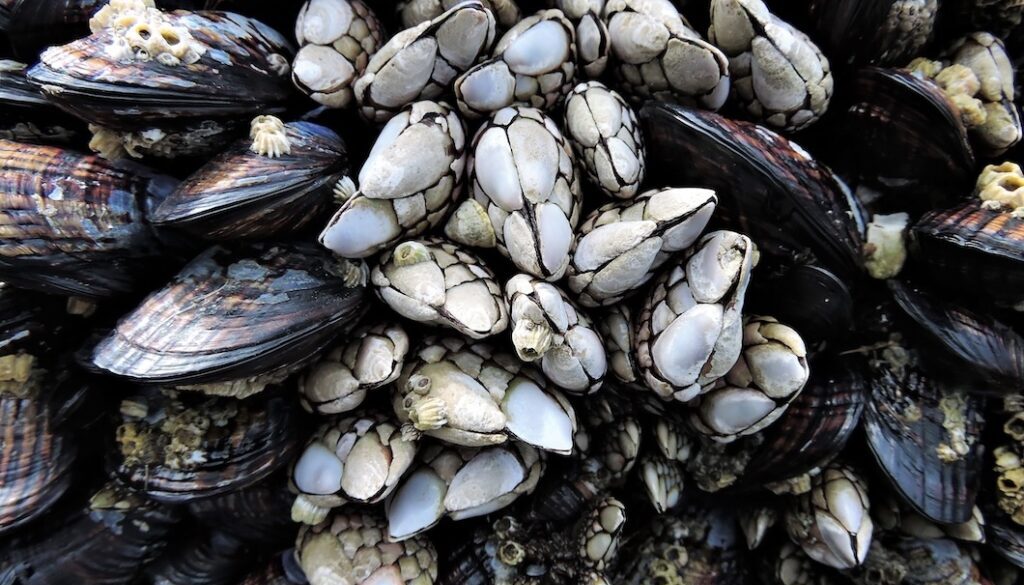
Biofouling is the accumulation of marine organisms like barnacles and algae on submerged or partially submerged surfaces.
The intertidal zone is a harsh environment. Many marine organisms find refuge from strong currents and predators on marine structures, cementing themselves to quay walls, pontoons, and piles. Once attached, they remain fixed in place for life, gradually forming dense colonies. Barnacles are among the most common and structurally significant forms of fouling.
The extent and rate of fouling depend heavily on site conditions such as water temperature, salinity, nutrient availability, tidal range, and current velocity. As a result, biofouling is highly predictable at a regional and site-specific level — a key reason it should be a design consideration during the earliest stages of marine projects.
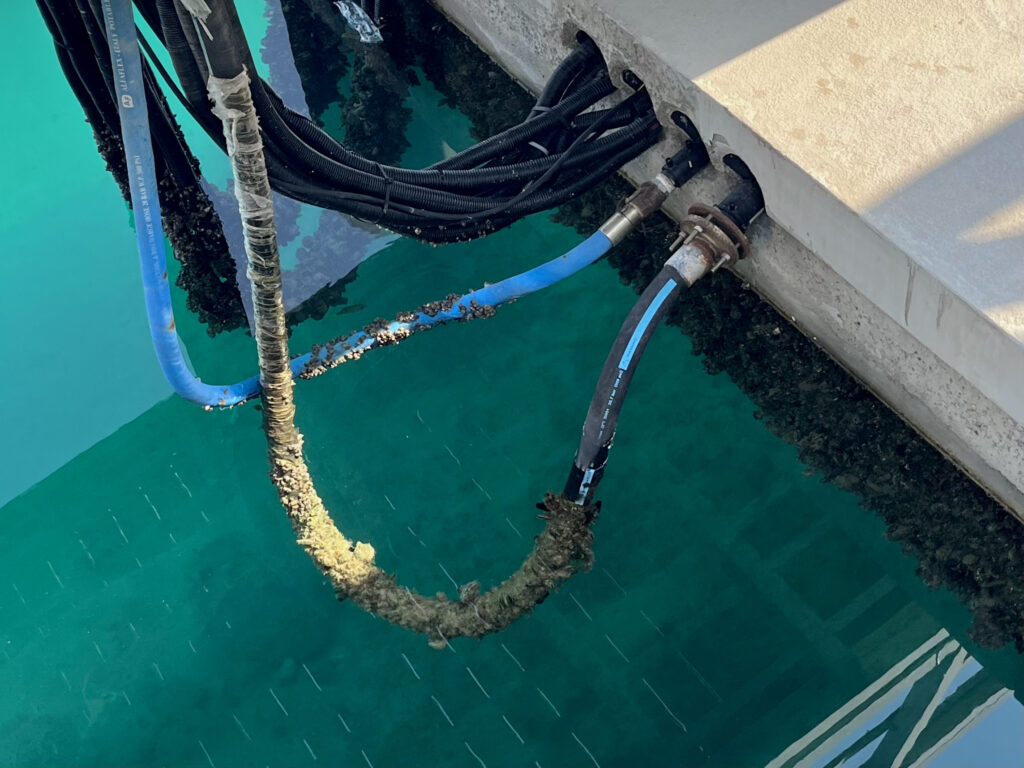
Pictured above: example of biofouling on submerged sections of a pontoon and plumbing, taken on 11.01.2026 at Marsa Al Arab Marina.
Biofouling Design Consideration
As marine growth accumulates, it alters loading conditions, hydrodynamic behaviour, and material performance in ways that directly influence structural design and long-term reliability. Understanding these implications at the design stage allows engineers to make informed decisions that improve performance, durability, and safety over the asset’s service life.
Dead Load
On floating structures, biofouling contributes additional weight that increases gradually over time as organisms accumulate. While individual barnacles might be small, widespread growth across pontoon units and underside framing can result in a significant increase in dead load. The uneven distribution of this weight can cause poorly designed pontoons to sag, tilt, or even buckle over time.
If this added weight is not considered during buoyancy and stability calculations, it can lead to reduced freeboard and diminished performance over the asset’s service life. In extreme cases, it may affect compliance with operational or safety criteria. Good design development anticipates this by allowing for fouling-related load increases rather than assuming a “clean” structure indefinitely.
Hydrodynamic Load
Barnacle growth increases effective diameter and surface roughness. Even modest increases in effective diameter due to fouling can have a disproportionate impact on hydrodynamic forces, and surface roughness further elevates drag forces when structures are subjected to currents, waves, and vessel-induced flow.
From an engineering perspective, this can influence lateral load calculations, pile sizing, and fatigue performance, particularly in energetic environments or locations with strong tidal flows. Accounting for these effects during design development improves the reliability of structural models and reduces uncertainty during technical review and approvals.
Material Durability
Biofouling also affects how materials age. Barnacle colonies create microenvironments under their shells that trap moisture, sediment, and organic matter against structural surfaces, which can accelerate deterioration if protective systems are compromised.
While some studies suggest that barnacle formations may improve the durability of concrete by acting as a ‘biocover’, we find that these protective effects are outweighed (literally) by the dead load increase through bioaccumulation on floating structures.
Timber and metal materials, however, are more susceptible to damage. Timber pilings are particularly vulnerable to marine borers, and any break in a protective wrap (which barnacles can facilitate by growing along seams) allows them to enter and cause structural damage. For steel and aluminium structures, barnacles can promote corrosion at attachment points or at coating defects, weakening the metal.
Thoughtful material selection and detailing of surface finishes or joint geometry, for example, play a critical role in managing long-term durability.
Anti-Fouling Coatings
The application of anti-fouling coatings can also inhibit marine growth. These coatings generally work either by hindering the adherence of organisms to coated surfaces or preventing them from settling in the first place.
Traditional antifouling paints are biocides, and leach toxic substances such as copper to kill the larvae of organisms that would typically settle on marine structures. Due to environmental concerns, new technologies have emerged that alter the physical and chemical properties of coated surfaces, making it much harder for marine organisms to adhere.
While these coatings discourage biofouling settlement and colonisation, marine structures will still require maintenance, i.e., physical cleaning and removal, in the long term.
Designing for Reality
Biofouling is a natural phenomenon and an unavoidable reality of putting any kind of structure in water. Good marine engineering consultants acknowledge this reality instead of assuming on-site conditions will remain as clean as they are in renderings, or placing accountability entirely on asset owners.
Robust marine engineering acknowledges that growth will occur and ensures that structures perform as designed despite it. By addressing biofouling as early as the design stage, we can:
- reflect realistic load and performance assumptions
- support smoother approvals and peer reviews
- reduce lifecycle risk for asset owners
Small Organisms with Big Implications
Barnacles, mussels, and algae may be small, but their influence on marine structures is anything but. When biofouling is treated as a design consideration rather than a maintenance afterthought, marine infrastructure performs more predictably and lasts longer. For marine engineering consultants, design success often comes down to how well we anticipate the environment — and the organisms that call it home.